Minimally invasive laser-assisted treatment for pilonidal sinus disease, same-day procedure with faster healing and lower recurrence than traditional excision.


Pilonidal Sinus at a Glance
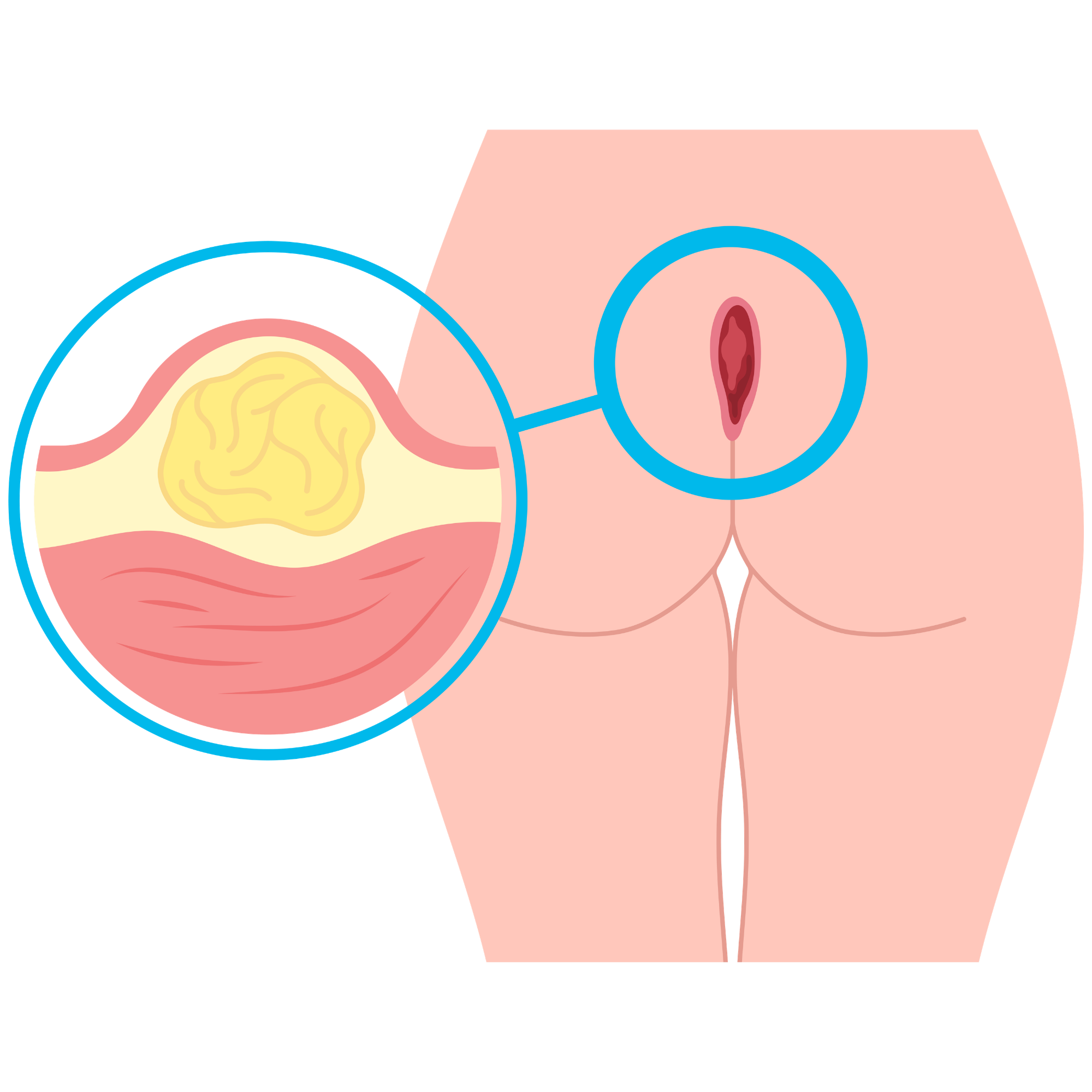
A pilonidal sinus is a small tunnel or channel in the skin at the top of the cleft between the buttocks, known as the natal cleft. It typically contains loose hairs and debris that have been pushed beneath the skin surface by friction and pressure. These tracts become infected repeatedly, forming painful abscesses that discharge pus. Without definitive treatment, the cycle of infection, drainage and recurrence continues for years.
The condition most commonly affects young men between the ages of 15 and 35, particularly those with coarse body hair, a deep natal cleft or jobs involving prolonged sitting. Obesity and poor natal cleft hygiene are contributing factors. Once established, pilonidal sinus does not resolve on its own, surgical treatment is necessary to eliminate the tract permanently.
Traditional surgery involves cutting out the entire sinus and leaving a large open wound that takes 6 to 12 weeks to heal. This is painful, requires daily wound dressings and forces most patients off work for weeks. SiLaC (Sinus Laser Closure) destroys the sinus tract from within using a laser probe, leaving only a tiny external puncture. Recovery takes days rather than weeks, recurrence rates are lower, and patients go home the same day.
Book a consultation with Dr. Prashanth J V today.
Book Consultation 📞 +91 93533 16175The procedure takes 30 to 45 minutes under spinal or general anaesthesia. Any active infection or abscess must be treated and fully resolved before the laser procedure is performed on the residual sinus tract.
Spinal or general anaesthesia is administered. The patient is positioned prone (face down) to give clear access to the natal cleft. The area is cleaned and sterile drapes placed.
A probe is passed into the sinus to map its full extent. Any secondary tracts or pits are identified and marked. The internal anatomy is confirmed before laser treatment begins.
The sinus tract is curetted to remove any hair, debris and granulation tissue. This prepares the tract walls for effective laser ablation and significantly improves closure rates.
A radially emitting laser probe is introduced into the tract. As it is slowly withdrawn, laser energy destroys the sinus lining from within, causing the tract to collapse and seal permanently. Secondary tracts are treated in the same way.
The small external openings are closed with a single absorbable suture or left as tiny punctures. A simple dressing is applied. Most patients go home within 4 to 6 hours.
Home the same day. Mild soreness at the treatment site is normal. Take prescribed analgesics. Keep the area clean. Avoid prolonged sitting for the first 48 hours.
Return to desk work within 3 to 5 days. Some mild discharge from the treated area during the first week is normal as the tract heals from within. Keep clean with gentle washing.
The external openings close progressively. Discharge reduces significantly. Resume normal activity including light exercise. Continue keeping the natal cleft hair-free.
Complete healing in most cases. A follow-up confirms closure. Long-term natal cleft hair removal, regular shaving or laser hair removal, is strongly recommended to prevent recurrence.
Pilonidal disease presents in three broad ways, and the right treatment depends on which one you have.
| Presentation | What you notice | Usual approach |
|---|---|---|
| Asymptomatic pits | One or more small midline dimples in the natal cleft, noticed incidentally, with no pain or discharge. | Often no treatment. Hair removal and hygiene advice. |
| Acute abscess | Rapid onset of severe pain, a hot tender swelling just off the midline, sometimes with fever. | Urgent incision and drainage to relieve the acute problem. |
| Chronic discharging sinus | Intermittent or continuous discharge of pus or blood, soreness on sitting, and one or more visible pits. | Definitive treatment once inflammation has settled. |
| Recurrent disease | A sinus that returns after previous surgery, often with scarring from earlier procedures. | Careful reassessment. Technique chosen to suit the scarred field. |
The distinction between an abscess and a chronic sinus matters practically. An abscess is an emergency that needs draining, and that drainage is not definitive treatment. It relieves the pain, but the underlying sinus usually remains and needs addressing separately once the acute infection has settled.
Discharge is often the symptom that finally prompts people to seek help. Continuous staining of underwear, odour and the need to sit carefully at work are wearing, particularly in young adults who are otherwise well.
Pilonidal disease is acquired rather than congenital. The natal cleft is a warm, moist, hair-bearing area subject to constant friction and suction as you move. Loose hairs, often shed from the head or back rather than growing locally, work their way into the skin through the midline pits. The body cannot expel them, so it walls them off in a cavity that becomes chronically infected.
More hair in the natal cleft means more shed hairs available to penetrate the skin.
Deeper clefts trap hair and moisture and are subject to greater friction and negative pressure.
Drivers, office workers and students spend hours with the cleft compressed, which drives hair inward.
The condition is considerably more common in men and typically presents between the late teens and thirties.
Deepens the natal cleft and increases friction and moisture.
Repeated rubbing from clothing or activity contributes to hair penetration.
Moisture and debris in the cleft favour infection once hair has penetrated.
Hair type and body habitus run in families, so the tendency does too.
Understanding the mechanism explains why treatment alone is not enough. If the tract is closed but hair continues to be driven into the same area, the process can simply begin again. This is why hair removal is part of the treatment rather than an optional afterthought.
The diagnosis is clinical and is usually obvious on examination. The purpose of assessment is less about confirming the diagnosis and more about defining the extent of the disease.
Examination. One or more small pits are seen in the midline of the natal cleft. Hair may be visible protruding from a pit. There may be a secondary opening to one side, which is where the tract has discharged. Gentle probing defines the direction and length of the tract.
Assessing extent. The number of pits, the presence of side branches, the degree of scarring from previous surgery and the depth of the natal cleft all influence which technique is appropriate. This assessment is what determines whether a minimally invasive approach is likely to succeed.
Imaging. Rarely needed. MRI is occasionally used in extensive or recurrent disease to map complex tracts, or where the diagnosis is uncertain.
Distinguishing a pilonidal sinus from a perianal fistula matters, because the two are treated entirely differently. Position is the main clue: pilonidal disease sits in the natal cleft, well away from the anus.
Laser sinus closure suits most people with a chronic discharging sinus and limited disease, and it is particularly attractive to those who cannot afford weeks away from work or study.
| Usually suitable | Needs discussion first |
|---|---|
| Chronic discharging sinus with one or a few midline pits | An active abscess, which needs drainage first before definitive treatment |
| A well-defined tract of limited length | Very extensive disease with multiple widely separated tracts |
| First presentation, or recurrence with limited scarring | Heavy scarring from several previous operations, which may favour a flap procedure |
| A wish to avoid a large open wound and prolonged dressings | A very deep natal cleft, where a cleft-flattening flap procedure may give a more durable result |
| Ability to attend follow-up and commit to hair removal | Poorly controlled diabetes or active smoking, which impair healing |
Where an abscess is present, drainage comes first. Attempting definitive closure in the middle of acute infection gives poor results. Definitive treatment is usually arranged several weeks later once inflammation has settled.
A painful or discharging lump at the top of the buttocks?
Assessment tells you whether the sinus needs treatment now, and which technique suits its size and history.
Preparation is simple and most people continue normal activity beforehand.
Pilonidal disease has a well recognised tendency to recur whatever technique is used, and it would be misleading to present any procedure as a guaranteed cure. Minimally invasive laser closure offers a much easier recovery, and where it does not fully succeed it can generally be repeated or followed by a more extensive procedure without having burned any bridges.
| Effect | How often | What it means |
|---|---|---|
| Discomfort on sitting | Common | Soreness for several days to a week, eased by simple analgesia and a cushion. |
| Serous discharge | Common | Clear or blood-stained discharge for one to two weeks while the tract heals from within. |
| Delayed healing | Occasional | More likely in smokers, in diabetes, and where the natal cleft is deep. |
| Wound infection | Occasional | Managed with antibiotics, and drainage if a collection forms. |
| Recurrence | Recognised and not rare | The condition returns, particularly where hair removal and hygiene are not maintained. |
| Seroma or haematoma | Uncommon | A collection of fluid or blood, which may need to be drained. |
| Persistent non-healing wound | Uncommon | Needs reassessment, and occasionally a flap procedure. |
| Scarring | Expected but usually limited | Considerably less than after wide excision, since much less tissue is removed. |
Options range from very minor procedures with quick recovery and moderate durability, through to larger operations with longer recovery and lower recurrence. The right balance depends on how extensive the disease is and how much time you can afford to lose.
| Treatment | How it works | Recovery | Recurrence risk |
|---|---|---|---|
| Incision and drainage | Releases pus from an acute abscess. Relieves the emergency but is not definitive. | Days, with dressings | High, since the sinus remains |
| Pit picking (Bascom) | The midline pits are excised through tiny incisions and the cavity is cleaned through a lateral opening. | About a week | Moderate |
| Laser sinus closure (SiLaC) | A laser fibre destroys the lining of the cleaned tract so it collapses and seals. | A few days | Low to moderate |
| Endoscopic treatment (EPSiT) | The tract is visualised with a fine endoscope, cleaned of hair and debris, and ablated under direct vision. | About a week | Low to moderate |
| Excision with primary closure | The diseased tissue is removed and the wound closed. Midline closure has higher failure rates than off-midline. | 2 to 3 weeks | Moderate, and higher if closed in the midline |
| Flap procedures (Limberg, Karydakis) | Diseased tissue is excised and a flap of healthy tissue flattens the natal cleft, removing the underlying cause. | 3 to 4 weeks | Low, particularly in extensive or recurrent disease |
| Excision left open | The wound heals slowly from the base by secondary intention. | 6 to 12 weeks of dressings | Low, but at a considerable cost in time |
A reasonable strategy for most people with a first presentation is to begin with a minimally invasive option, since it costs little in recovery time and preserves every other option if it does not succeed. Extensive or repeatedly recurrent disease is usually better served by a flap procedure that addresses the deep cleft itself.
Asymptomatic pits found incidentally often need nothing more than hair removal and sensible hygiene. A sinus that is discharging or repeatedly becoming infected is a different matter.
Recurrent abscesses. Each episode brings several days of severe pain, usually needs drainage, and leaves further scarring that makes eventual definitive treatment more difficult.
The tract network extends. Repeated infection produces additional pits and side branches. Disease that would have suited a small laser procedure can become extensive enough to require a flap operation.
Daily impact. Constant discharge, staining and odour, along with difficulty sitting through lectures, long drives or a working day, affect confidence and daily life considerably. This is often the real cost of leaving it untreated.
Rare long-term risk. Malignant change within a very long-standing, chronically discharging sinus is described but is genuinely rare. It is mentioned for completeness rather than as a reason for alarm.
This section matters more in pilonidal disease than in almost any other condition treated on this website. The procedure closes the tract, but hair continuing to penetrate the same area is what brings the problem back. Aftercare is not an afterthought here. It is half the treatment.
People who maintain hair removal and hygiene after treatment do considerably better than those who do not, regardless of which procedure they had. It is worth taking seriously.
#38/2, 2nd Main Road, Madiwala New Extension, Bangalore 560068, behind Ayyappa Temple. Convenient for BTM Layout, Koramangala, HSR Layout, Bommanahalli and Hosur Road.
Dr. Prashanth J V also consults in Koramangala, Jayanagar and Seshadripuram. When you call, the team will confirm the most convenient location for a pilonidal sinus.
Consultations are by appointment. Call +91 93533 16175 or request an appointment online.
SiLaC laser treatment avoids the large open excision wound that makes conventional pilonidal surgery so prolonged and painful. Tiny punctures heal in days, not months.
Extensive experience treating first-time and recurrent pilonidal sinus, including complex multi-tract cases that have failed previous conventional surgery.
No prolonged hospital stay or daily wound dressing appointments. Go home the same day and return to desk work within 3 to 5 days.
Medical References & Further Reading
This page is written and medically reviewed by Dr. Prashanth J V, MBBS, MS, FMAS, FISCP, DMAS, Karnataka Medical Council Registration No. 41048. It is general health information about pilonidal sinus disease and does not replace an individual consultation, examination and investigation. If you have symptoms, please seek personalised medical advice.
 Gallbladder Surgery
 Appendicectomy
 Hernia Repair
 Hysterectomy
 Ovarian Cystectomy
 Tubectomy & Ectopic
 Laser Piles
 Laser Fissure
 Varicose Veins
 Laser Fistula
 Pilonidal Sinus